The answer comes before the detail
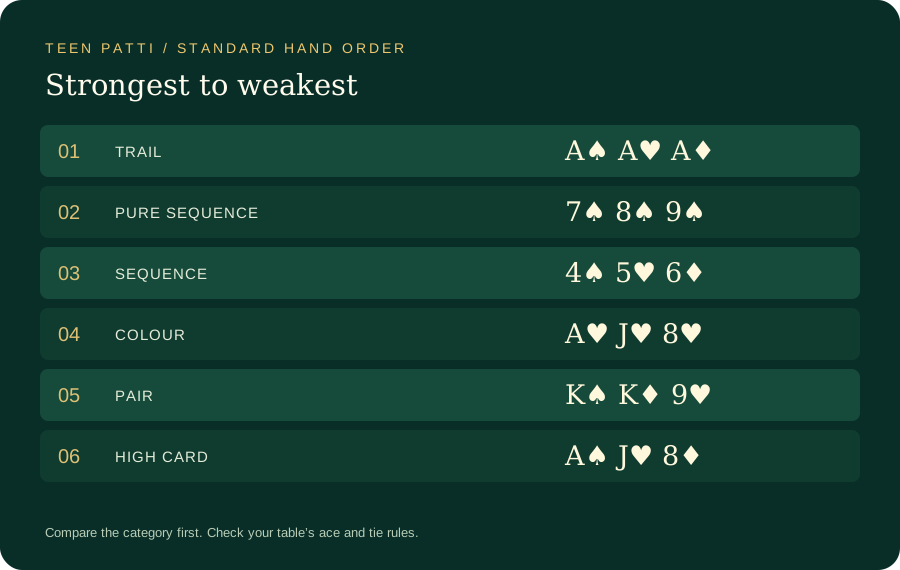
Trail > pure sequence > sequence > colour > pair > high card. Within a pair, compare the pair rank before the spare card.
Six categories, strongest first
| Order | Hand | Example | Meaning |
|---|---|---|---|
| 1 | Trail / trio | A♠ A♥ A♦ | Three of the same rank. Aces are highest. |
| 2 | Pure sequence | 7♠ 8♠ 9♠ | Three consecutive ranks in one suit. |
| 3 | Sequence / run | 4♠ 5♥ 6♦ | Three consecutive ranks, mixed suits. |
| 4 | Colour / flush | A♥ J♥ 8♥ | One suit without a consecutive run. |
| 5 | Pair | K♠ K♦ 9♥ | Two equal ranks and one kicker. |
| 6 | High card | A♠ J♥ 8♦ | No pair, run or flush; compare ranks. |
Compare within the same category
For a trail, compare the repeated rank. For a pair, compare the pair rank before the spare card, also called the kicker. A pair of queens with a three beats a pair of jacks with an ace. For colour and high card, sort ranks from high to low and compare the first difference.
For sequences, identify the run and then apply the table’s ace convention. Suits usually do not create a spade-over-heart hierarchy. If all relevant ranks match, use the table’s equal-hand rule rather than inventing a suit tiebreak.
Why poker intuition can be misleading
In standard three-card Teen Patti, a sequence outranks a colour. In familiar five-card poker, the corresponding straight and flush order is different. The number of cards changes how frequently these combinations occur. The category names may look familiar, but the chart must match the game being played.
Quick comparison drill
| Question | Answer | Reason |
|---|---|---|
| Three twos or three kings? | Three kings | Higher repeated rank. |
| 4-5-6 mixed suits or ace-high colour? | 4-5-6 | A sequence is a higher category. |
| A-A-2 or K-K-Q? | A-A-2 | The pair rank matters first. |
| A-J-8 or A-J-7, mixed suits? | A-J-8 | Highest and second ranks tie; compare the third. |
If you are searching for a “Teen Patti chart”, “Teen Patti hierarchy” or “Teen Patti order”, this is the same standard category reference. A variation such as Muflis may deliberately reverse it.
Equal does not always mean split
Two hands can have the same ranked values using different suits. A table may award an equal show against the requester or use another written convention. The chart identifies equal strength; it does not override settlement rules. Check those rules before using any app’s compare or show button.
Enter your own example
Use the hand comparison tool to choose two actual three-card hands and select the table’s ace convention. It checks for duplicate cards and explains the first difference. Equal hand strength is reported separately from a table’s settlement rule.
A four-step comparison method
- Classify both hands under the selected rule set.
- Compare category numbers before looking at individual ranks.
- When categories match, compare the category-specific rank values.
- If the values tie, consult the table’s show or sideshow rule instead of ranking suits.
Use the chart while learning an app
A comparison chart explains the game, while the Master APK source guide explains a file. Keep those two checks separate: knowing which hand is stronger does not establish who published an Android package.
Sources & scope
Reviewed 28 October 2026. Rules and service details may vary. Source records and calculation methods are explained in Sources & methods. See our editorial policy.