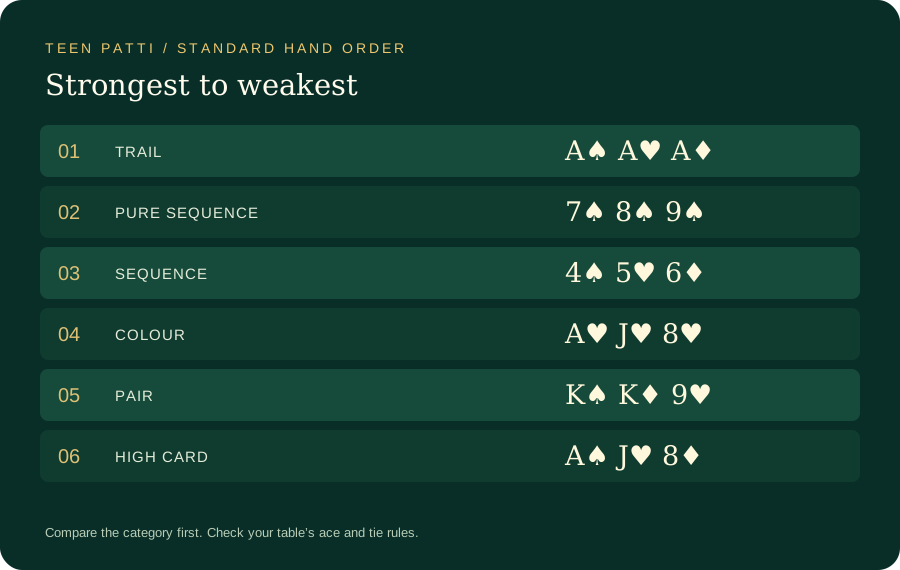
Ace order is a table rule
A23-high and AKQ-high are both documented. Pure sequence beats ordinary sequence before the ace-order question matters.
Pure sequence versus ordinary sequence
| Cards | Category | Why |
|---|---|---|
| 7♠ 8♠ 9♠ | Pure sequence | Consecutive ranks, same suit. |
| 7♠ 8♥ 9♦ | Sequence | Consecutive ranks, mixed suits. |
| 2♥ 7♥ J♥ | Colour | Same suit, no consecutive run. |
| K♠ A♥ 2♦ | High card | Ace does not join king to two. |
A pure sequence is above every ordinary sequence in standard category order. First ask whether all suits match, then identify the run. A colour cannot become a sequence merely because its cards look close together.
Does A-2-3 beat A-K-Q?
There is no single safe answer without the table rule. Pagat’s documented convention puts A-2-3 first and A-K-Q next. Other published game rules put A-K-Q first and A-2-3 second. Neither sequence should be labelled universally highest across all apps.
| Convention | First | Second | Then |
|---|---|---|---|
| A23-high | A-2-3 | A-K-Q | K-Q-J down to 4-3-2 |
| AKQ-high, A23-second | A-K-Q | A-2-3 | K-Q-J down to 4-3-2 |
Some tables use other ace conventions. Check the exact help screen. Our practice trainer avoids comparisons that depend on choosing one of these conventions.
Valid runs and the wraparound mistake
The ordinary consecutive runs include 2-3-4 through J-Q-K and Q-K-A, plus the special ace-low A-2-3 run when allowed. Writing Q-K-A or A-K-Q describes the same three ranks. K-A-2 is not a continuous run under either convention above. A-2-4 is also not a sequence.
An unsuited 2-3-5 hand is high card in standard play. A special house variation can assign it unusual power, but that exception must be explicitly agreed; it does not belong in the default chart.
How to settle a sequence dispute
- Check that both hands belong to the same category.
- Find the table’s ace-high or ace-low wording.
- Compare the runs using that wording.
- If the ranks match, apply the written equal-hand rule; do not rank suits by preference.
- If a variation changes wild cards, return to that variation’s rules before comparing.
Put the ace rule into an actual comparison
Compare A♠ 2♥ 3♦ against A♥ K♦ Q♣. Both are ordinary sequences. Under A23-high, the first is stronger; under AKQ-high with A23 second, the second is stronger. Now make the first hand A♠ 2♠ 3♠: its pure-sequence category beats the ordinary sequence under either ace convention.
The comparison tool lets you switch between these two conventions. It is intended for standard hands without wild cards.
Questions, answered
Is K-A-2 a sequence?
No, not under the standard conventions explained here.
Is 2-3-5 the strongest Teen Patti hand?
Not in standard Teen Patti. Special house rules must be agreed separately.
Sources & scope
- Pagat: traditional rules (includes one ace-order convention)
- Published rules showing the alternative AKQ-first convention
Reviewed 28 October 2026. Rules and service details may vary. Source records and calculation methods are explained in Sources & methods. See our editorial policy.